
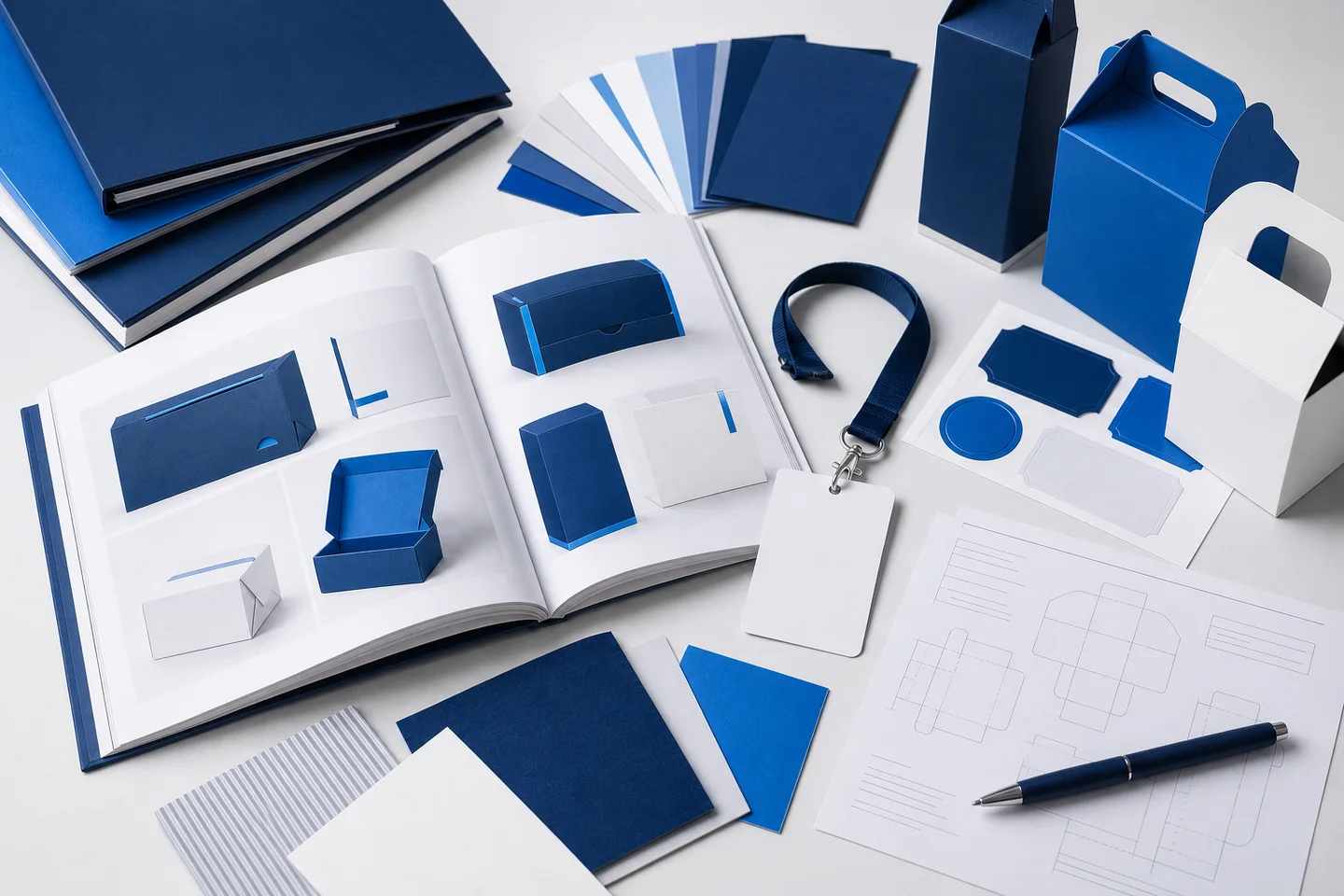
Packaging and Print Planning for Türkiye Trade Fairs
A trade fair gives a buyer only a few minutes to understand an offer, decide whether it is relevant and remember what to do next. Print and packaging material should therefore operate as one decision system, not as a last-minute collection of catalogues, cards and giveaways. The most useful planning question is simple: what does this buyer need to carry into an internal discussion, compare with another option or use to request a technically meaningful quotation?
Start with the intended buyer conversation
Map each likely conversation before selecting formats. A visitor approaching from the aisle needs a clear category signal. A buyer at the table may need a concise product sheet, a relevant physical sample and room to record specifications. A procurement team following up after the event needs a traceable reference, a maintained digital destination and a structured enquiry route.
This creates three practical layers. Stand-facing material explains the category without crowded claims. Meeting material helps sales teams discuss a specific use case. Decision material captures the information needed after the meeting. A Product Blueprint can connect those layers by recording product type, dimensions, quantity, intended market, artwork status and required date.
Keep samples organised by application rather than appearance alone. A cosmetic carton, textile catalogue, food-sector label and presentation box answer different questions. Mark every sample with a neutral reference that the sales team can use in follow-up. Do not present a concept visual as a completed customer project, and do not print a material, certification or compliance statement unless its owner has approved evidence for that exact project.
Treat every language as a production version
International fairs often require English or additional languages, but translation is only one step. Product names may become longer, units can be interpreted differently, and approved market wording needs sufficient space. Review each language on the final dieline or page layout. Check headings, contact details, dates, barcode areas and calls to action. Test every QR code at its intended printed size and confirm that it opens a relevant page in the same language.
Event references also need publication-day review. As of 15 August 2026, the 2026 editions of IIFF and BEAUTYISTANBUL have concluded; they must not be described as upcoming. The IIFF organiser lists 19–23 January 2027 at Tüyap Fair Center and Istanbul Expo Center. BEAUTYISTANBUL lists 3–5 June 2027 at Tüyap Fair Center. Eurasia Packaging Istanbul is listed for 13–16 October 2026 at Tüyap, while WorldFood Istanbul is listed for 15–18 December 2026 at Istanbul Expo Center. These dates do not imply that Furkan Ofset will exhibit, attend or deliver to any venue.
Build backwards from the fixed date
Create a schedule from the organiser’s current date and rules, then work backwards through packing, quality review, production release, proof approval, artwork completion and briefing. Assign one accountable owner to copy, artwork, proof, release and delivery coordination. Record the latest acceptable decision date for every stage instead of treating all late changes as emergencies.
Before packing, count items by meeting area or team, scan each QR code, compare visible surfaces with the approved file and record missing components. Keep a replacement plan, but do not promise emergency production or venue delivery unless operations has approved it for the specific order.
Convert interest into a procurement-ready follow-up
A stack of business cards is not a qualified pipeline. During or immediately after the meeting, capture the application, product dimensions, quantity band, destination market, artwork status, proof requirement and target date. Note which sample or product family was discussed. The follow-up can then ask for the missing technical inputs rather than sending a generic company presentation.
Separate contacts by intent. Someone researching options needs an educational resource; a buyer with dimensions and quantities needs a technical review; a team with approved artwork may be ready for a quotation brief. This routing makes the material useful after the fair and gives procurement a clear next step without unsupported promises.
Product Blueprint CTA: Preparing for a buyer meeting? Send product type, dimensions, quantity, target market, artwork status and deadline. Furkan Ofset can review the brief and identify the next technical question.